
Is ColdFusion still worth learning in 2026, or is it finally dead?
That's the question anyone weighing CFML has to answer before investing any time in it. The honest answer isn't a clean yes or no. ColdFusion is not a mainstream language anymore, but it's also far from dead. A meaningful number of enterprise, government, and healthcare applications still run on it every day, and modern ColdFusion looks very different from the version a lot of developers remember from the early 2000s.
"Isn't ColdFusion dead?" (or dying, or obsolete — pick your preferred phrasing) is usually the first reaction people have, and it's a fair one. The language's reputation is still stuck somewhere around 2005, when it was mostly known for tag soup and a syntax that looked nothing like anything else. That reputation is out of date. Let's go through what's actually true.
What ColdFusion actually looks like today
CFScript, the modern script-based syntax covered throughout this site's course, reads far closer to JavaScript or Java than the old tag-heavy style most people associate with the language. Arrow functions, closures, functional array/struct operations like map/filter/reduce, null-safe operators: it's all there.
Both major engines, Adobe ColdFusion and the open-source Lucee, are actively developed, with regular releases, modern language features, and real security patching. Neither is an abandoned project frozen in time.
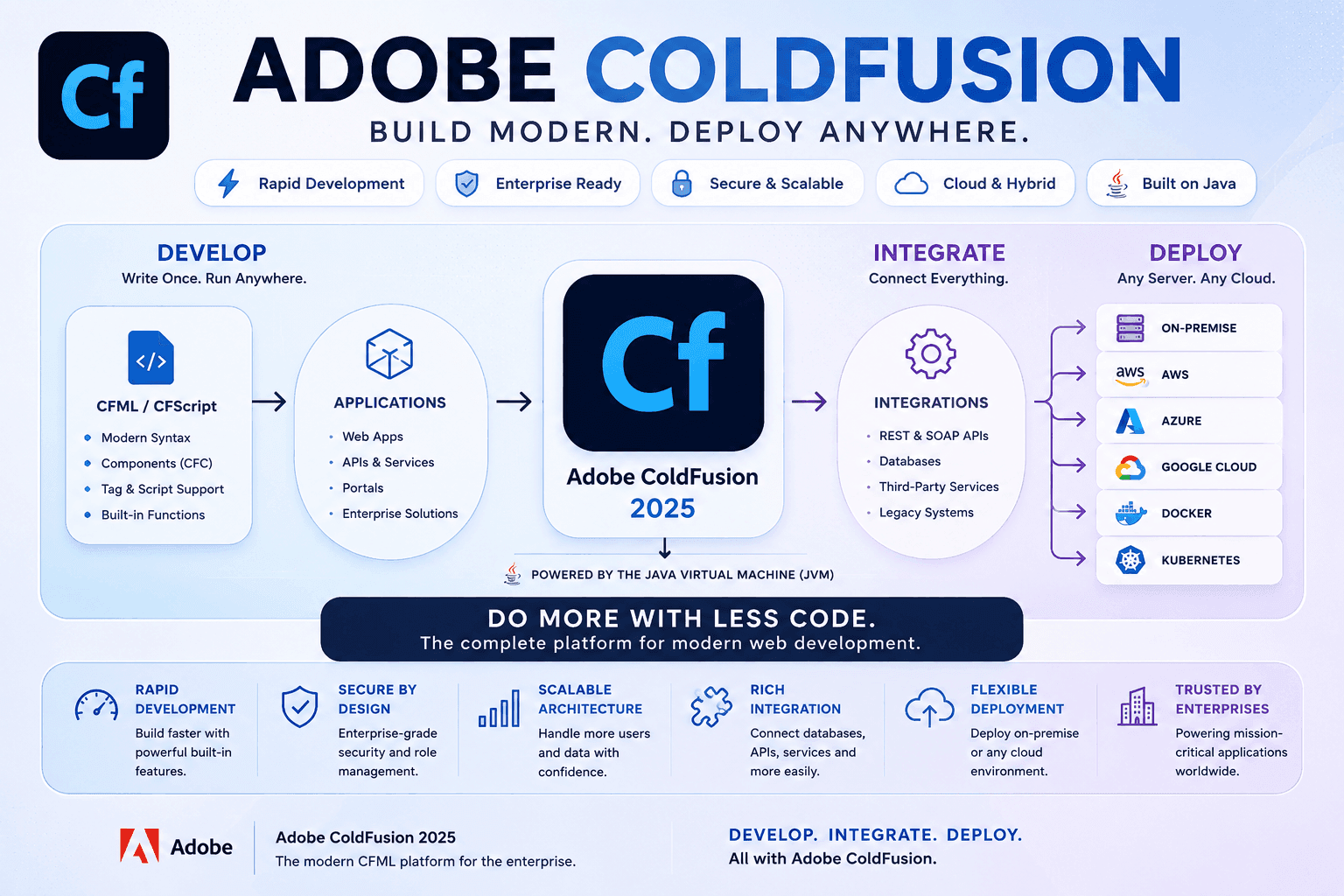
One detail that surprises a lot of people: Adobe ColdFusion and Lucee both run on the Java Virtual Machine. That means CFML code can call Java libraries directly (createObject("java", ...) in CFScript) whenever it needs something outside the built-in feature set, giving it access to the entire Java ecosystem without ever leaving CFML. It also means CFML can talk to any HTTP-based API, including AI providers like OpenAI, Gemini, Claude, or Azure OpenAI, the same way any other server-side language does, through a standard HTTP request.
Who still uses ColdFusion?
ColdFusion's overall market share is much smaller than JavaScript, Java, or Python's. That's not in dispute. What is true is that a meaningful number of production applications remain in active use across a specific set of industries.
Government and public-sector systems
A significant amount of ColdFusion-built infrastructure sits inside government agencies, where systems built 10-20 years ago are still in daily production use and get incrementally maintained rather than rewritten.
Insurance, healthcare, and finance
Industries with long software lifecycles and heavy compliance requirements tend to keep working systems running for a very long time: rewriting a production financial or healthcare system is expensive and risky, so many never get rewritten at all.
Established e-commerce and internal business tools
Plenty of companies built their core order-processing, inventory, or internal admin tools in ColdFusion years ago, and those systems are often still exactly what runs the business today.
Modernization projects, not just maintenance
Many organizations aren't just keeping old ColdFusion applications alive as-is. They're modernizing them: containerizing with Docker, migrating to cloud platforms like AWS or Azure, exposing existing logic through REST APIs, and pairing the backend with a modern front end such as React or Vue. That work still requires someone who knows CFML.
Why learn ColdFusion in 2026?
Here's the part most "is X worth learning" articles skip: the honest economic argument, not just "it's still used somewhere."
Far less competition than JavaScript or Python
Thousands of developers graduate every year already knowing React or Python. Very few know ColdFusion. If a company genuinely needs someone to maintain or extend an existing CFML system, the pool of people who can do that is small, and that scarcity works in your favor.
Existing systems need maintainers, indefinitely
Software that's been running in production for over a decade doesn't disappear on its own. Someone has to patch it, extend it, and keep it secure, and that someone increasingly needs to be actively sought out, not assumed to already be on staff.
It's genuinely fast to pick up if you know another language
If you already understand variables, conditionals, loops, and functions in any C-family or JavaScript-like language, CFScript specifically is one of the faster languages to become productive in, since the syntax gap is much smaller than people assume.
Are ColdFusion developers still paid well?
This is really what a lot of people mean when they ask if it's "worth it." There's no honest way to quote a specific number here (pay varies enormously by country, industry, and company), but the general shape of the market is worth understanding: because experienced ColdFusion developers are relatively rare, companies that depend on CFML applications often can't easily replace them, which tends to keep compensation for that specific skill competitive rather than commoditized. There are fewer openings than for Java or JavaScript roles, but there are also far fewer qualified applicants per opening. Treat this as a directional signal, not a promise.
Advantages of learning ColdFusion
- + Easy to pick up if you already know JavaScript, Java, or C#, since modern CFScript syntax is familiar
- + Less competition for the roles that do exist, since far fewer developers specialize in it
- + Runs on the JVM, with direct access to Java libraries when CFML's built-ins aren't enough
- + Built-in, low-code features for database access, email, PDF generation, file uploads, scheduled tasks, and REST APIs, meaning less boilerplate for common backend tasks
- + A steady, ongoing need for maintainers across government, healthcare, finance, and established enterprise applications
- + Modern language features: CFScript, closures, functional array/struct operations, null-safe handling
- − Smaller community, with fewer tutorials, open-source libraries, forums, and conferences than mainstream languages
- − Fewer job postings overall, even though competition per posting is typically lower
- − The outdated tag-syntax reputation is a real perception problem: some people assume you're behind the curve just for knowing it
- − Rarely used for brand-new, greenfield projects or startups, which mostly reach for Node.js, Python, Java, or Go instead
- − Adobe ColdFusion requires a paid commercial license for production use (Lucee, the open-source alternative, is free)
- − Not a good choice as your only language — it works best as an addition to a broader skill set, not a replacement for JS/Python/SQL
Who this actually makes sense for
Good fit
You already have (or are building) other web development skills and want a genuinely differentiating, lower-competition skill to add. You're specifically interested in legacy system maintenance, government/enterprise contracting, or working at a company you already know runs ColdFusion.
Skip it (for now)
You're choosing your very first and only programming language with no other context — a more mainstream language will open more doors faster when you're starting from zero.
ColdFusion vs. spending that time elsewhere
| Factor | Learning ColdFusion | Learning JavaScript/Python |
|---|---|---|
| Learning curve if you know another language | Fast — syntax is close to JS/Java | Fast — huge amount of learning material |
| Job posting volume | Lower | Much higher |
| Competition per job posting | Low | High |
| Community size / tutorials | Small | Massive |
| Existing enterprise systems needing maintainers | Significant, ongoing | N/A — different market |
| Value as a sole/only skill | Weak | Strong |
| Value as an added skill alongside others | Strong, differentiating | Expected baseline |
Frequently asked questions
Is ColdFusion still used in 2026?
Yes. A meaningful number of enterprise and government applications continue to run on ColdFusion, particularly systems that have evolved over many years and require ongoing maintenance and new features rather than a full rewrite.
Is ColdFusion easy to learn?
If you already know JavaScript, Java, C#, or a similar language, modern CFScript is generally straightforward, since the syntax and control-flow concepts are familiar. Most of the learning curve is CFML's specific built-in functions rather than the language itself.
Is Lucee better than Adobe ColdFusion?
Neither is universally better. Adobe ColdFusion is commercial software with vendor support and enterprise features; Lucee is open source, free, and widely used in production. The right choice depends on the project's budget, existing tooling, and support requirements.
Should beginners learn ColdFusion as their first language?
Generally no. If you're completely new to programming, starting with JavaScript or Python gives you a broader foundation and far more learning resources. ColdFusion tends to be most valuable as an additional backend skill, learned after you already know the basics elsewhere.
Continue learning
A few good places to start if you want to see what modern CFML actually looks like:
The short version
ColdFusion isn't dead, and it isn't the outdated tag-based language most people picture when they hear the name. Modern CFML looks and feels close to JavaScript, runs on the JVM, and is still actively maintained by both Adobe and the Lucee project. It's also genuinely not the right choice as your only language.
If your goal is to build modern web applications from scratch, JavaScript or Python should probably be your first language. But if you're looking to stand out in enterprise development, maintain real production systems, or add a differentiated backend skill on top of what you already know, ColdFusion remains a practical, low-competition option in 2026.
This course teaches modern CFScript using Adobe ColdFusion 2025 and Lucee, with real code examples and no fluff. It's a reasonable place to find out for yourself whether CFML fits where you want to take your development skills.