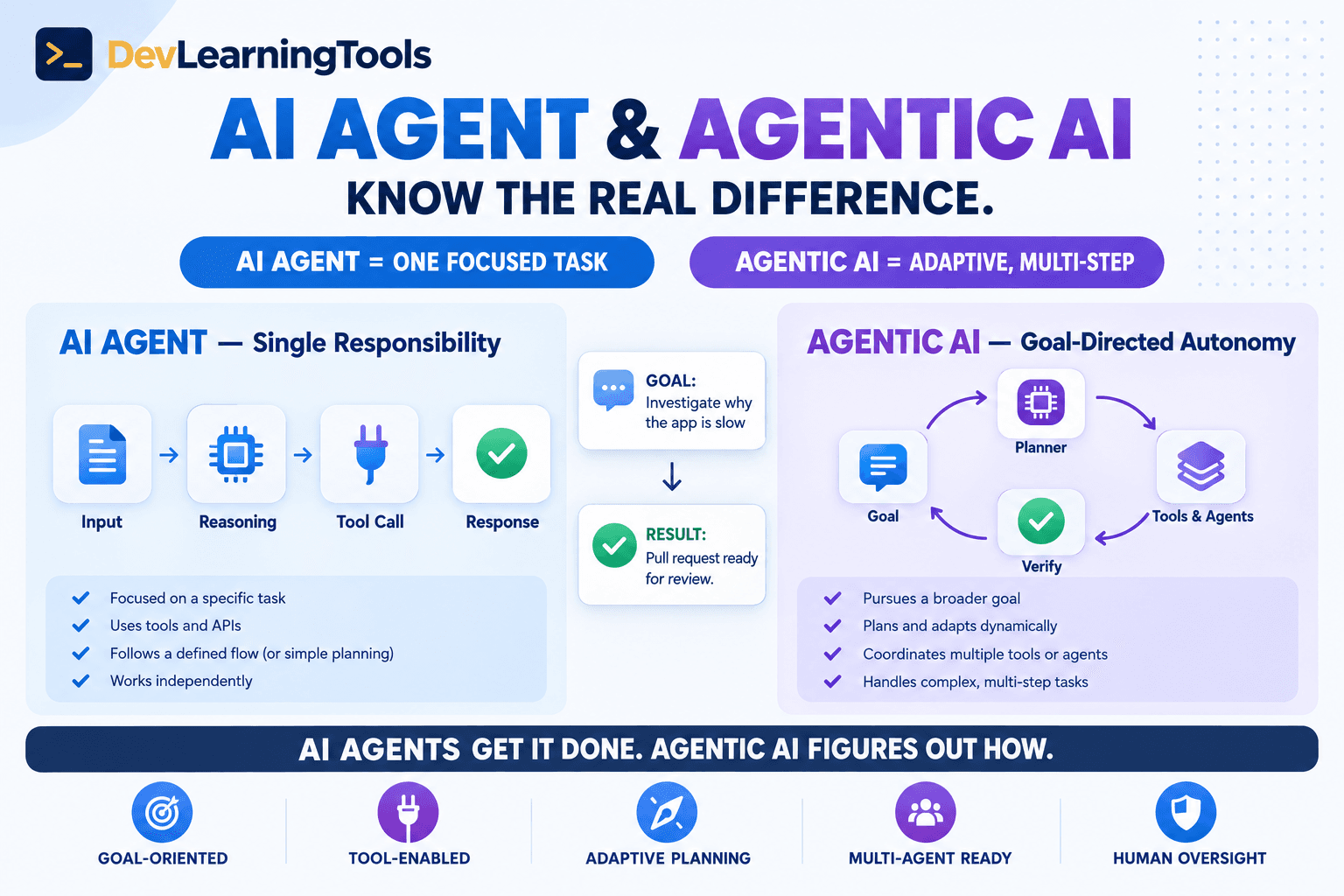
Two terms, one real distinction
Artificial intelligence is moving beyond generating text and answering questions. Modern AI systems can use tools, analyze information, plan multiple steps, interact with software, and work toward specific goals. Two terms frequently used to describe these capabilities are AI agents and agentic AI.
Although these terms are closely related, they are not always interchangeable. Understanding the difference helps developers, software architects, and businesses decide whether they need a task-specific AI agent, a coordinated AI workflow, or a more autonomous system.
What Is an AI Agent?
An AI agent is a software system that uses artificial intelligence to interpret information, make decisions, and perform actions to achieve a defined goal.
Depending on its design, an AI agent may use a large language model (LLM), external tools, APIs, databases, memory, or predefined rules. Unlike a basic AI application that only returns an answer, an AI agent can interact with its environment and perform additional steps when required.
- Goal-oriented: works toward a specific objective.
- Context-aware: uses available information to make decisions.
- Tool-enabled: can call APIs, search databases, or execute approved functions.
- Action-oriented: performs tasks instead of only generating responses.
- Feedback-driven: can inspect results and retry or adjust its approach when designed to do so.
- Permission-controlled: operates within assigned access rights and constraints.
Example: A Customer Support AI Agent
Imagine an online store receives a customer request: "I want to know where my order is." A customer support AI agent might:
Understand the request
Parse the customer's message to identify what they're actually asking for.
Extract the order number
Pull the relevant identifier out of the message or the customer's account context.
Call the order management API
Query the system that actually knows the order's real-time status.
Retrieve the shipping status
Read the structured result the API returns.
Generate a response
Turn the raw status into a clear answer using the information retrieved.
What Is Agentic AI?
Agentic AI refers to an AI approach or system designed to pursue goals through autonomous, context-dependent decisions and actions.
An agentic AI system may use one AI agent or coordinate multiple specialized agents. It can plan a sequence of actions, select tools dynamically, evaluate results, and adapt its approach when circumstances change. The defining characteristic is not simply the number of agents, it's the system's ability to determine how to make progress toward a goal rather than relying entirely on a fixed sequence of instructions.
- Dynamic planning: determines the next steps based on the current situation.
- Goal-driven execution: focuses on completing an outcome rather than one isolated operation.
- Adaptive behavior: can change its approach when new information appears.
- Tool orchestration: selects and coordinates different tools or services.
- Multi-step execution: handles tasks that require several connected operations.
- Optional multi-agent collaboration: can assign specialized subtasks to different agents.
- Human oversight: uses approval checkpoints, escalation, and permission limits where necessary.
An AI agent can itself be highly autonomous. Agentic AI does not automatically mean multiple agents. The terms overlap, and their exact definitions vary across organizations and technical frameworks.
Example: An AI-Powered Software Development Assistant
Suppose a developer gives an AI system this instruction: "Investigate why our application is slow, identify the likely cause, propose a fix, and prepare a pull request." An agentic AI system could work through this as a changing sequence of actions, not a single fixed script:
Inspect logs and metrics
Pull application logs and performance data to find where time is actually being spent.
Identify suspicious queries
Narrow down to the database queries that look like real bottlenecks.
Examine the relevant source code
Read the code paths behind those queries.
Develop a hypothesis
Form a specific theory about what's actually causing the slowdown.
Propose a code change
Draft a fix targeting that hypothesis.
Run permitted tests
Execute the test suite against the proposed change.
Inspect the results
Check whether the tests actually passed.
Revise if needed
If tests failed, adjust the fix and try again rather than giving up.
Prepare a pull request
Package the verified change for human review.
Request comes in as plain language
Agent reads the existing codebase
Agent plans the multi-file change
Agent writes and executes the change
Agent verifies with a real build
Change is committed and shipped
AI Agents vs Agentic AI: Key Differences
| Feature | AI Agent | Agentic AI |
|---|---|---|
| Meaning | An AI-enabled software actor | An approach or system that exhibits goal-directed autonomy |
| Scope | Often a defined task or responsibility | Often a broader, multi-step objective |
| Autonomy | Can range from limited to high | Emphasizes adaptive, goal-driven execution |
| Planning | May follow predefined steps or create plans | Often dynamically determines the next steps |
| Tool usage | Uses assigned tools | May coordinate tools and agents |
| Architecture | Can be a single component | Can contain one or multiple agents plus conventional software |
| Adaptability | Depends on implementation | Adaptation is an important design objective |
| Collaboration | Can operate independently | May coordinate multiple specialized agents |
| Complexity | Can be relatively simple | Can be more complex to design and govern |
| Example | Order-status lookup agent | End-to-end shipment exception management system |
These differences describe common architectural patterns, not universal rules. A single AI agent can perform complex planning, while an agentic workflow can use several agents, ordinary software components, or a combination of both.
A Simple Analogy
Think of a software development team. An AI agent is like a developer assigned to investigate a particular bug: it can inspect code, run tests, and suggest a fix. Agentic AI is like a coordinated process that investigates the issue, prioritizes the work, identifies a solution, tests the changes, prepares a review, and checks whether the objective has been achieved.
That coordinated process might use one capable agent, or several specialized ones; what makes it "agentic" is the coordination and adaptive decision-making, not the headcount.
How AI Agents Work
An AI agent commonly operates through an observe, decide, act, and evaluate cycle. Not every agent implements all of these stages explicitly, some use fixed steps, while others use dynamic reasoning and repeated tool calls.
- Receive an instruction: the agent gets a request, event, or objective, like "find all failed API requests from the past hour."
- Understand the context: identify the necessary parameters, available data, and constraints.
- Select an action: decide whether to query logs, call an API, search a database, or ask for more information.
- Execute the action: invoke an approved tool or function.
- Evaluate the result: check whether the retrieved information actually answers the question, or whether another action is required.
- Return the outcome: provide the result, report a failure, or request human assistance.
Input
A request or event
Reasoning
Understand the context
Tool Call
Execute an action
Observation
Check the result
Response
Return the outcome
How Agentic AI Works
Agentic AI uses similar mechanisms but applies them to a broader objective that may require a changing plan. Consider an instruction: "Investigate our website's performance and prepare a prioritized improvement report."
- Define measurable objectives.
- Gather performance metrics.
- Examine server logs.
- Analyze database query timings.
- Identify potential bottlenecks.
- Gather evidence for each finding.
- Rank possible improvements by impact and risk.
- Recheck uncertain findings.
- Generate a report with supporting evidence.
- Stop when the completion criteria are satisfied.
User Goal
The broad objective
Planner
Decides what to do next
Tools / Agents
Specialized execution
Verification
Checks the work
Final Outcome
Delivered result
If the first hypothesis is incorrect, the system may choose another investigation path. A more complex architecture could delegate log analysis, database analysis, and code review to specialized agents, with an orchestrator combining their findings. This architecture is useful when tasks are open-ended or require different capabilities; a deterministic workflow is often better when every step is already known and must execute in a predictable order.
Architecture and Components
Both AI agents and agentic AI systems typically draw on the same underlying building blocks:
- Large language model: interprets instructions, reasons over context, selects tools, or generates structured outputs.
- Tools and APIs: let the system interact with external applications: REST APIs, SQL databases, search engines, file systems, code execution environments, monitoring platforms.
- Memory and state: memory maintains relevant context across steps; state records what's already happened, what remains to be done, and whether the objective is complete. Memory should be designed carefully so stale or irrelevant information doesn't influence decisions.
- Planning and orchestration: planning determines a possible sequence of actions; orchestration coordinates execution, tool access, agent communication, retries, and handoffs.
- Evaluation and verification: evaluation checks whether an action produced the intended result; verification can include unit tests, database constraints, schema validation, business rules, or human review.
- Security and governance: permissions, approval gates, audit logs, spending limits, timeouts, and termination conditions help prevent unintended actions.
Real-World Examples, Side by Side
| Domain | AI Agent | Agentic AI |
|---|---|---|
| E-commerce support | Retrieves order status and answers delivery questions. | Investigates a delayed shipment, checks inventory and delivery info, evaluates resolution options, drafts a response, and escalates exceptions. |
| Software development | Explains a function, reviews a snippet, or runs an approved test. | Investigates an issue, explores the repo, proposes changes, runs tests, evaluates failures, and prepares a pull request. |
| Cybersecurity | Enriches a security alert with threat intelligence. | Correlates several alerts, gathers endpoint/network evidence, prioritizes the incident, recommends containment, requests approval for sensitive actions. |
| Data analysis | Runs a SQL query and summarizes the returned rows. | Investigates a business question, identifies relevant tables, generates and validates queries, explores anomalies, creates a report. |
| IT operations | Checks whether a server is reachable. | Investigates an outage, correlates logs and metrics, identifies likely causes, recommends remediation, executes preapproved recovery actions when safe. |
| Marketing and content | Generates an article outline or a caption. | Researches a topic, prepares a draft, checks editorial requirements, creates platform-specific versions, schedules approved content. |
Autonomy should not be confused with permission to publish, spend money, delete data, or change production systems without oversight.
When an AI Agent Is the Right Choice
- The objective is well-defined.
- The required tools are known.
- The task can be completed within a limited scope.
- You need flexible decisions but not a complex coordinating system.
- Cost, speed, and maintainability are priorities.
When Agentic AI Is the Right Choice
- The goal is clear but the exact steps are not.
- The system must adapt to changing information.
- Several applications or data sources are involved.
- The task requires repeated investigation and verification.
- The value of flexible execution justifies the added complexity.
When You Don't Need Either
Don't use an agent just because the task involves AI. A simple API call, database query, rules engine, scheduled job, or single LLM response is often more reliable and affordable for a predictable task.
Where Should You Use Each?
| Requirement | Recommended Approach | Reason |
|---|---|---|
| Format JSON | Deterministic function or simple AI tool | Fixed, predictable task |
| Answer questions from a knowledge base | RAG, optionally with an agent | Retrieval may be enough |
| Retrieve an order status | Task-specific AI agent | Narrow goal with clear tools |
| Classify support tickets | Traditional model or AI agent | Depends on classification complexity |
| Investigate an unfamiliar production issue | Agentic workflow or agentic AI system | Requires iterative investigation |
| Generate and test code changes | Coding agent with controlled tools | Needs multiple actions and verification |
| Reconcile complex business exceptions | Agentic AI with approval gates | Requires decisions across multiple systems |
| Process a predictable invoice pipeline | Deterministic workflow, AI for extraction only | Fixed sequence and validation rules |
| Research and compare multiple sources | Agent with search tools, or agentic workflow | May need repeated searches and evaluation |
| Execute high-risk financial transactions | Human-controlled workflow, restricted automation | Errors can have significant consequences |
Advantages and Disadvantages of AI Agents
- + Focused responsibilities: a narrowly scoped agent is easier to understand and test.
- + Automation: agents can handle repetitive knowledge work.
- + Tool integration: can retrieve information and perform approved actions.
- + Flexible responses: LLM-based agents can interpret natural language requests.
- + Incremental adoption: start with one agent and expand when necessary.
- − Incorrect outputs: the model may misunderstand instructions or produce unreliable results.
- − Tool errors: API failures and unexpected responses can interrupt execution.
- − Limited context: an agent may not have enough information to make a good decision.
- − Security concerns: tool access can expose data or enable unintended actions.
- − Testing challenges: different model responses can make behavior less predictable.
Advantages and Disadvantages of Agentic AI
- + Complex task execution: can coordinate several dependent operations.
- + Adaptive planning: can change its approach when new evidence appears.
- + Cross-system integration: can combine information from different services.
- + Reduced manual coordination: can automate handoffs and intermediate steps.
- + End-to-end outcomes: works toward a measurable objective, not just an answer.
- − Higher operating costs: multiple model calls and tool operations add up.
- − Increased latency: multi-step execution can take longer than a single request.
- − More failure points: errors can propagate through connected actions.
- − Complex debugging: hard to identify which decision caused a failure.
- − Security and governance risks: broad permissions increase the impact of mistakes.
- − Evaluation difficulty: success must be measured across the whole workflow.
- − Unpredictable completion: the system may take unnecessary steps or never converge.
AI agents are often easier to introduce for a focused task. Agentic AI can offer greater flexibility for complex objectives, but it requires more careful engineering, evaluation, monitoring, and governance.
AI Agents vs Agentic AI vs Generative AI
Generative AI can be a component of an AI agent. An AI agent can be part of an agentic AI system. A multi-agent architecture is one possible implementation, not a mandatory requirement for agentic behavior.
| Technology | Main Purpose | Example |
|---|---|---|
| Generative AI | Creates content or predictions | Generates a Python function |
| AI agent | Uses AI to pursue a task and potentially take actions | Edits a file and runs a test |
| Agentic AI | Goal-directed autonomy in a broader AI system | Investigates an issue, tests fixes, prepares a reviewed change |
| Traditional automation | Executes predefined rules and steps | Runs a nightly database backup |
| Multi-agent system | Coordinates two or more agents | Research, analysis, and review agents collaborate on a report |
Python Example: A Task-Specific Agent Pattern
The following examples use ordinary Python to illustrate the control flow of a narrow task-specific agent versus a goal-directed process. They don't require an LLM or any AI framework, and they are not complete production implementations.
Suppose a monitoring agent must check the status of a known service:
A fixed-responsibility monitoring agent
One known service in, one status-based message out: no branching investigation, no tool selection.
def check_service(service_name):
    # In production, call an authorized monitoring API.
    service_status = {
        "payment-api": "healthy",
        "email-api": "degraded"
    }

    return service_status.get(service_name, "unknown")


def monitoring_agent(service_name):
    status = check_service(service_name)

    if status == "healthy":
        return f"{service_name} is healthy."

    if status == "degraded":
        return f"{service_name} requires investigation."

    return f"Status for {service_name} is unavailable."


print(monitoring_agent("email-api"))Expected output: email-api requires investigation. This is a simplified task-specific monitoring pattern, a fixed responsibility, not an LLM-powered autonomous agent.
Python Example: A Goal-Directed Investigation Workflow
Now consider a process that checks service status, retrieves diagnostic information when necessary, and validates whether a report has enough evidence before recommending an action:
A conditional investigation workflow
Status drives whether diagnostics are even collected, and the recommendation depends on whether the evidence actually verifies.
def check_service(service_name):
    return "degraded"


def get_diagnostics(service_name):
    return {
        "service": service_name,
        "error_rate": "high",
        "recent_deploy": True
    }


def verify_diagnostics(diagnostics):
    return (
        diagnostics["error_rate"] != "unknown"
        and diagnostics["service"] is not None
    )


def investigate_service(service_name):
    status = check_service(service_name)

    if status == "healthy":
        return {
            "status": status,
            "investigation_required": False
        }

    diagnostics = get_diagnostics(service_name)
    verified = verify_diagnostics(diagnostics)

    return {
        "status": status,
        "diagnostics": diagnostics,
        "evidence_verified": verified,
        "recommended_action": (
            "Review recent deployment"
            if verified and diagnostics["recent_deploy"]
            else "Collect additional evidence"
        )
    }


print(investigate_service("payment-api"))This is a goal-directed workflow with conditional steps, not a fully autonomous agentic AI implementation, its paths are explicitly coded. A genuine LLM-driven agentic system would dynamically select tools or next steps based on its reasoning, available observations, and execution constraints.
What Would Change in a Production Implementation?
Start with a deterministic workflow when possible. Add model-driven planning only where it provides measurable value.
- An LLM to interpret the investigation goal.
- Tool definitions for monitoring, logs, and deployment history.
- A controlled loop for selecting and executing tools.
- State management and termination conditions.
- Evidence-based verification.
- Retry limits, timeouts, and cost budgets.
- Human approval before changing production services.
Common Mistakes to Avoid
- Treating AI agents and agentic AI as completely separate technologies: they overlap; explain the distinction through scope, planning, and orchestration rather than rigid labels.
- Assuming agentic AI always requires multiple agents: a single agent with dynamic planning and tool use can exhibit agentic behavior on its own.
- Using agents for every task: simple calculations, data transformations, fixed business rules, and predictable API calls may not need one.
- Giving agents excessive permissions: separate read access from write access, and use approval gates for consequential actions.
- Allowing unlimited execution loops: without iteration limits, an agent may repeatedly call tools, increase costs, or fail to stop.
- Trusting model-generated answers without verification: validate against authoritative sources, schemas, test results, database constraints, or business rules.
- Confusing a workflow with an autonomous agent: a predefined sequence with AI calls is still a workflow; dynamic, model-directed execution is the real signal.
- Ignoring failure handling: plan for timeouts, malformed tool responses, unavailable services, and contradictory results.
- Measuring success only by whether the final answer looks correct: also measure task completion, tool-call success, latency, cost, and unintended side effects.
- Ignoring prompt injection and untrusted data: treat retrieved documents, emails, and files as data, never as authorization to change the system's rules or permissions.
Security and Best Practices
Agentic systems can affect real applications and data. Security has to be part of the architecture from the beginning, not bolted on afterward.
- Apply least privilege: give each agent access only to the required tools, records, and operations.
- Use human approval: require confirmation for sensitive or irreversible actions.
- Validate tool inputs: apply schemas, parameter validation, and authorization checks.
- Protect secrets: keep API keys and credentials in a secure secrets manager.
- Use execution limits: set timeouts, maximum tool calls, rate limits, and budget controls.
- Log important actions: record tool calls, outcomes, approvals, and failures without unnecessarily exposing sensitive data.
- Verify results: use deterministic checks wherever possible.
- Isolate code execution: run generated code in a restricted environment.
- Test adversarial cases: evaluate prompt injection, unauthorized requests, data leakage, and unexpected tool outputs.
- Provide a safe fallback: stop and escalate when the system can't verify a result or exceeds its permissions.
A useful principle: make the system as autonomous as necessary, but no more autonomous than the task requires.
Interview Questions: Beginner
What is an AI agent?
An AI agent is a software system that interprets context, makes decisions, and performs actions toward a goal. It may use an LLM, APIs, databases, or other tools.
What is agentic AI?
Agentic AI describes AI systems designed to pursue goals through planning, tool use, adaptive decisions, and potentially coordinated execution across multiple steps.
What is the main difference between AI agents and agentic AI?
An AI agent describes a software actor, while agentic AI describes a broader approach or system behavior. The distinction isn't absolute, since an individual agent can exhibit substantial autonomy on its own.
Does agentic AI always require multiple agents?
No. A single agent can plan and execute multiple steps on its own. Multi-agent collaboration helps when tasks benefit from specialized responsibilities or parallel work, but it isn't a requirement.
Is a chatbot an AI agent?
Not necessarily. A chatbot that only generates responses isn't automatically an agent. A chatbot that selects tools, retrieves information, performs actions, and evaluates outcomes is functioning as one.
Interview Questions: Intermediate
What are the main components of an AI agent?
Common components include a model or decision engine, instructions, tools, context, state or memory, an execution loop, and safety controls.
What is the difference between an AI workflow and an AI agent?
An AI workflow usually follows a predefined execution path. An agent can dynamically decide which actions or tools to use based on the current state. Real systems often combine both patterns.
What is a multi-agent system?
A multi-agent system contains multiple agents that collaborate, communicate, or divide responsibilities to complete a larger objective.
What is tool calling?
Tool calling lets a model-driven system request the execution of a defined function or external operation, such as querying a database or retrieving a record.
What is the role of memory in agentic AI?
Memory and state help the system retain relevant context, record completed actions, track progress, and avoid repeating unnecessary steps. It isn't required for every agent, simple ones can be stateless.
Interview Questions: Advanced
How would you design a reliable agentic AI system?
Start with a measurable objective, select the simplest suitable architecture, define available tools, restrict permissions, implement state tracking, set termination conditions, verify results, and monitor quality, latency, cost, and safety.
How do you prevent an AI agent from entering an infinite loop?
Use maximum iteration counts, execution deadlines, repeated-action detection, budget limits, explicit completion criteria, and safe escalation when the objective can't be completed.
How would you evaluate an agentic AI system?
Evaluate end-to-end task success, correctness, tool-call accuracy, policy compliance, robustness, latency, cost, and unintended side effects, across representative and adversarial scenarios.
What is the biggest security risk in an autonomous AI system?
There's no single universal biggest risk. Important ones include excessive permissions, prompt injection, sensitive data exposure, unauthorized actions, and cascading errors, which one matters most depends on the environment and available tools.
When would you avoid agentic AI in a production application?
When a deterministic workflow solves the problem adequately, when the task requires strict predictable behavior, when the potential harm of incorrect actions is high, or when monitoring and governance aren't in place yet.
Interview Questions: Scenario-Based
Your company wants to automate customer refunds. Would you use an AI agent or agentic AI?
Start with a controlled workflow: an AI component to interpret requests if needed, deterministic business rules to verify eligibility, and an authorized service to process refunds. A more agentic system can help investigate exceptions, but refunds need strict limits, idempotency protections, audit logs, and human approval for high-risk cases.
How would you implement a retry mechanism for a tool-using agent?
Use a bounded number of attempts, distinguish retryable errors from permanent ones, apply exponential backoff where appropriate, and avoid repeating non-idempotent actions without safeguards, see the retry pattern example below.
A Simple Retry Pattern for Tool Calls
A robust retry implementation should use a bounded number of attempts, distinguish retryable errors from permanent errors, and back off between attempts rather than hammering the same failing call:
Bounded retry with exponential backoff
Three attempts, doubling the wait each time, only for a TimeoutError specifically, not every possible failure.
import time


def call_with_retry(operation, max_attempts=3):
    for attempt in range(max_attempts):
        try:
            return operation()
        except TimeoutError:
            if attempt == max_attempts - 1:
                raise

time.sleep(0.5 * (2 ** attempt))This is a simplified retry utility. Production implementations should also account for API-specific retry guidance, cancellation, rate limits, and duplicate side effects on non-idempotent operations.
Future Trends in AI Agents and Agentic AI
Adoption will depend not only on model capability but also on reliability, operational cost, measurable business value, and governance.
- Coding agents: systems that inspect repositories, propose changes, run tests, and prepare code reviews.
- Enterprise automation: AI-assisted handling of exceptions across customer support, finance, and IT.
- Multi-agent collaboration: specialized agents working under explicit coordination and evaluation rules.
- Improved tool standards: more consistent ways to expose tools and data sources to AI applications.
- Human-in-the-loop systems: better approval, review, and escalation mechanisms.
- Agent evaluation: more systematic testing of complete tasks instead of isolated model responses.
- Secure execution environments: stronger isolation, identity controls, and limited tool permissions.
Frequently Asked Questions
Are AI agents and agentic AI the same?
No, although the terms overlap. An AI agent is an individual software actor, while agentic AI describes goal-directed autonomy in an AI system or approach. An agentic system may use one agent or several coordinated agents.
Which is better: AI agents or agentic AI?
Neither is universally better. A focused agent is often suitable for a narrow task, while an agentic system may fit complex objectives that require dynamic planning and multiple actions.
Can an AI agent work without an LLM?
Yes. Agents existed before modern LLMs and can be rule-based, reactive, planning-based, or driven by other machine learning models. Many current language-based agents use LLMs for reasoning and tool selection specifically.
Is agentic AI fully autonomous?
Not necessarily. Autonomy depends on the system's design, permissions, operating environment, and approval requirements. Production systems should define clear limits and escalation paths.
What is the difference between agentic AI and generative AI?
Generative AI creates content such as text, images, and code. Agentic AI uses decision-making, tools, and action-oriented workflows to pursue goals, and may use generative AI as one of its components.
What are the most common applications of AI agents?
Customer support, information retrieval, coding assistance, data analysis, document processing, monitoring, and task automation.
What are the most common applications of agentic AI?
Multi-step IT investigations, software development workflows, research and analysis, business exception handling, and coordination across multiple enterprise systems.
Can agentic AI replace traditional automation?
Not in every case. Traditional automation remains valuable for predictable, repeatable operations. Agentic AI is most useful when flexible decisions or adaptation justify the added complexity.
Is agentic AI expensive?
It can be. Costs depend on model selection, the number of model calls, tool execution, context size, retries, infrastructure, and monitoring. Limiting execution and using deterministic tools for predictable tasks reduces cost.
What skills are required to build AI agents?
Programming, API integration, prompt and context design, structured data handling, tool calling, testing, security, and observability. Advanced systems may also need orchestration, distributed systems, and evaluation expertise.
Is a multi-agent system always more powerful than a single agent?
No. Multiple agents can improve task specialization and parallelism, but they also introduce communication overhead, coordination errors, additional cost, and more complex debugging.
How can developers get started with agentic AI?
Start with a small, well-defined use case. Implement a tool-enabled agent, evaluate its results, add state and verification, and introduce dynamic planning only when a simpler approach genuinely isn't enough.
Conclusion
AI agents and agentic AI are closely related concepts that describe different aspects of AI-powered task execution. An AI agent can focus on a particular responsibility, such as retrieving information, analyzing logs, or calling an API. Agentic AI emphasizes a system's ability to pursue broader goals through adaptive planning, multi-step execution, tool orchestration, and, when useful, collaboration between specialized agents.
The most important engineering decision isn't choosing the most autonomous architecture. It's choosing the simplest architecture that reliably achieves the desired outcome: start with deterministic software when the process is predictable, add an AI agent when flexible interpretation or tool selection provides value, and introduce more agentic behavior only when the problem genuinely requires dynamic planning, with appropriate limits, verification, and human oversight enforced throughout.
Definitions of AI agents and agentic AI vary across organizations and frameworks. This article uses the distinction between an individual agent and broader goal-directed system behavior as a practical engineering model, not as a universal taxonomy.